
I used to feel confused about budgeting. Learn how the 50/30/20 budgeting rule works; many people also find it complicated to save money and manage their expenses.
For that, a simple rule called the 50/30/20 budgeting method can help us manage money easily.
I tried myself; it took about 6 months to settle it, but it is an easy way to cut all unnecessary expenses focused only on needs.
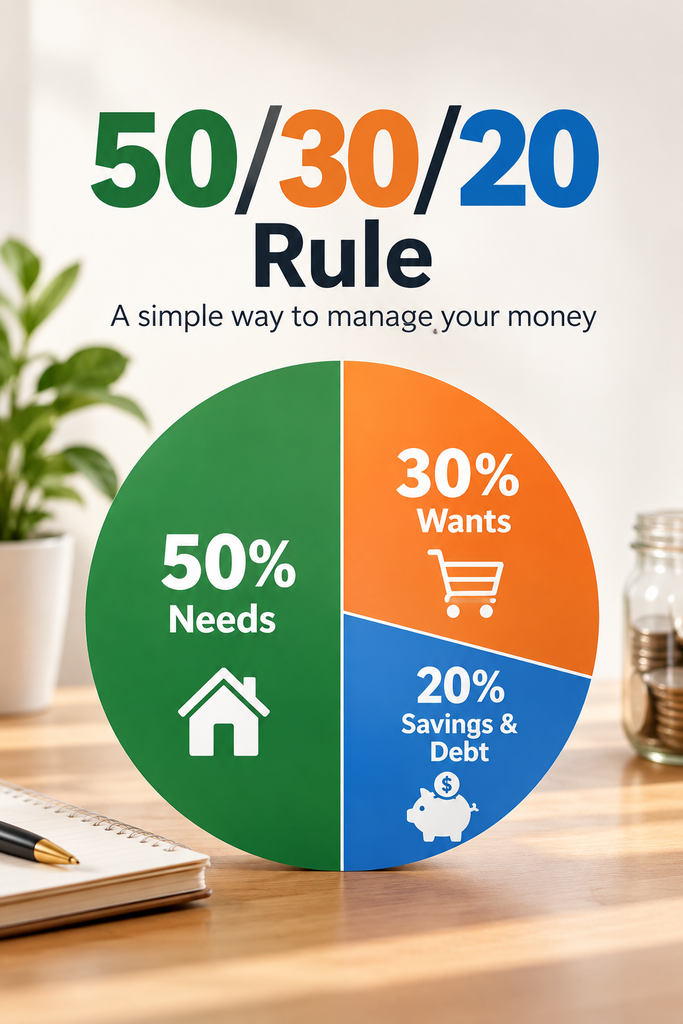
What is the 50/30/20 rule?
The 50/30/20 rule is a simple way to split your income into needs, wants, and savings. You can adjust it to your income (time.com) But if you follow this, you can cut down on your spending.
Many people have large financial obligations, such as paying the rent on their home, paying off debt, buying food each month, and normal family expenses, and this guideline helps you keep that spending in check.
It was popularized by Elizabeth Warren and her daughter, Amelia Warren Tyagi, in their book All Your Worth: The Ultimate Lifetime Money Plan.
How does this rule work?
Dividing your monthly income into three parts:
50% – Needs
30% – Wants
20% – Savings & Debt
Take the money you actually receive after taxes and divide it into these three categories.
It does not tell you what to buy. It gives you a simple plan for how much to spend in each group.
Start with a simple budget.
Many budgeting methods are too complicated, and people give up aftera short time.
In simple terms, the 50/30/20 budgeting rule is easier because
- It is easy to understand; you do not need special calculation apps
- It gives you freedom. Inside the 30 percent, you choose what to spend on.
- It gives balance. You can save money and also enjoy the things you like
- It can work with different incomes, like small or large income
First work with your needs 50%
Needs are the things you must spend money on. These are necessary expenses.
Examples like
→ Rent
→ Groceries
→ Electricity, water & other house bills
→ Transportation expenses such as fuel, bus fare, or car payments
→ Insurance
→ Minimum payment on loans.
If 50% of your income is not enough to cover your needs, your expenses may be too high compared with your income.
In this case you can try to reduce your costs. In high-rent areas, needs often pass 60/20/20 for a while and work backwards to 50/30/20.
People have changed from living in a big house to a small house and have started using only public transport for travel.
Enjoy life within your budget of 30%
Wants are the things you enjoy.
Examples include
→ Eating at restaurants
→ Streaming services like Netflix
→ Buying clothes that you don’t really need
→ Hobbies
→ Entertainment
→ Vacations.
It does not feel like a punishment. Cut back on spending that does not really make you happy, but keep the things you enjoy. If you stop everything, you may fail to budget.
Build a better future 20%
Savings and debt are important for building a better financial future.
Try to use this 20% for:
→ Building an emergency fund
→ Paying more than the minimum amount on your debt
→ Saving for retirement
→ Investing
→ saving for important future goals, such as buying a home.
If you have high-interest debt, try to pay it off quickly. After paying, focus on savings and investments. (Starting from zero? See built an emergency fund from $0)
Start your budget step by step.
You do not have to change everything at once. Start slowly and follow these simple steps.
Step 1: Know your monthly income.
First find out how much money you receive each month after taxes are taken out. This is your take-home pay. Use this number, not your gross salary.
Step 2: Divide Your Income
Multiply your income by each percentage.
Comparing a $2,000 income and a $3,500 income:
| Category | Percentage | $2,000 income | $3,500 income |
| Needs | 50% | $1,000 | $1,750 |
| Wants | 30% | $600 | $1,050 |
| Savings & debt | 20% | $400 | $700 |
Step 3: Track your expenses.
Track your expenses using these methods to effectively manage your income:
1. Spreadsheet 2. Notebook 3. Budgeting app
Choose any method to record your spending and help avoid unnecessary expenses.
Step 4: Make small changes
Check your spending and make small changes where needed. If you want to spend too much on wants, reduce them slowly instead of stopping everything at once.
Monthly review
At the end of each month compare your actual expenditures to your anticipated percentages. Look for categories you always seem to be overspending in and decide whether you can cut back on those expenses or modify your percentages.
Avoid common mistakes.
→ Plan for extra expenses: keep some money for expenses.
→ Don’t give up: If you overspend one month, don’t quit. again next month.
Who can follow this rule?
This rule works well for beginners who want a simple plan. Adjust the percentages to fit your situation.
Common Variations
| Split | Needs | Wants | Savings and debt | When it may help |
| 50/30/20 | 50% | 30% | 20% | The standard starting point |
| 60/20/20 | 60% | 20% | 20% | High rent or high living costs |
| 50/20/30 | 50% | 20% | 30% | You want to save or pay down debt faster |
These are common adjustments, not official rules. Pick the split you can stick with.
Final Thought
I suggested The 50/30/20 rule is simple to organize money towards needs, wants, savings, and debt. Start with your own numbers.
Financial Disclaimer
This article provides general financial and budgeting information for educational purposes only.